
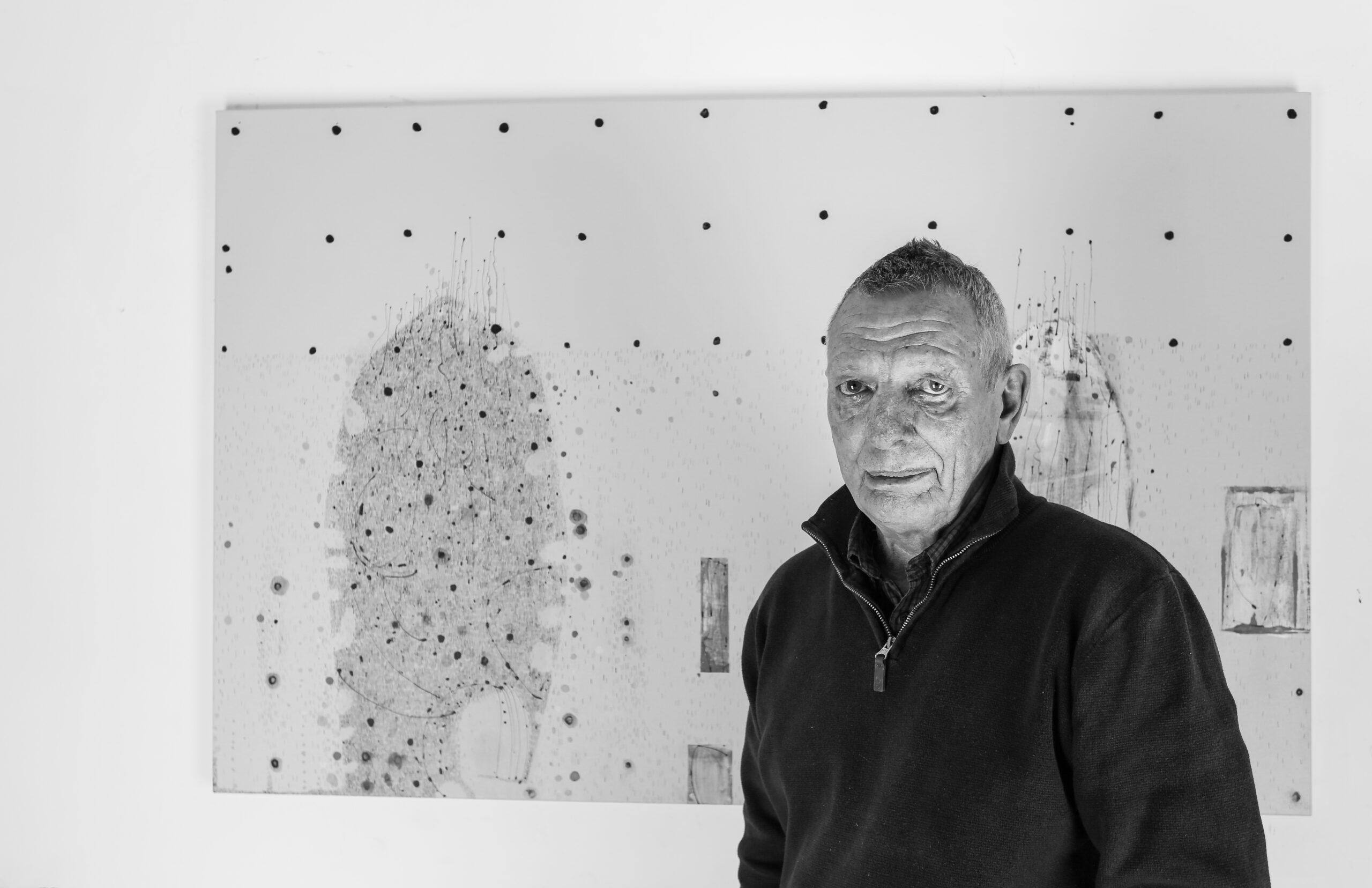
He grew up in Ayr, the birthplace of Robert Burns, and, by his own account, was not particularly exceptional in art at school. Yet he went on to become an artist whose landscapes are not the result of planning, but of a living dialogue between nature, free jazz and the material beneath his hands.
It is generally said that we all have some degree of artistic talent, but only some develop it to the point where they completely fall for it and it becomes their lifelong passion. How was it for you?
I was born and brought up in Ayr, a town on the west coast of Scotland and near to the birthplace of Robert Burns, Scotland’s national poet.
I was a keen student of art at school although I never regarded myself as having any special talent.
My fellow pupils were skilled at drawing animal and cartoon characters which I was hopeless at.
I suppose I was unconsciously self taught and aware of other artists through research at the town library. From an early age it was Vincent above all who was my biggest influence. His passion and directness was a great inspiration. It still is! In my last year at school I applied for Art College in Edinburgh (my art teacher reassuring me that “he would eat his hat” if I was successful!).
I thought at first that I would study Graphic Art but that soon changed with the freedom that study in Fine Art promised – though Edinburgh College of Art was still rooted in tradition, with an emphasis on figurative drawing. But I did arrive in the middle of the rebellion 60’s! There was great optimism for change and abstraction seemed to be the way forward. The Head of School on studio visits complained that there was no evident “blood or guts passion” in cool abstraction. In response I made a series of paintings with blood and guts as a theme.
What themes did you work on before and what themes are you mainly working on now? I often introduce you as a „Scottish landscape painter“, but as I have long understood, in your case it is „the landscapes of your soul“.
My themes and influences have been for a long time – the natural world and improvised music.
The response to nature was never in a literal or pictorial way but to echo shape and growth (I’m looking at unfurling fern in my garden in this early summer in a similar way to Karl Blossfeld’s photographs)
Music is a constant presence and influence in my studio activity. Since the 60’s I’ve tried to absorb the directness and freedom that listening to ‘free’ jazz has given me. I still have musician friends (many from an art school background) who I’ve collaborated with. I’ve designed an edition of album covers for Derek Bailey’s Incus record label. At the moment I’m making a series of “half paintings” that my master drummer friend, Han Bennink will complete.
We’ll have a show and concert together in the near future.
What does your typical day as an artist look like and what is your preparation before you materialise your vision on a (larger) canvas or sculpt it in clay?
My typical day is try to do something. If I’m energetic, I will work fast, but usually – it’s slow.
The ‘Balance’ title reflects this – I think about something gestural and fast then in contrast it’s painstakingly slow and sometimes tedious. I don’t want it to be easy.
I try not to plan the big paintings and I don’t prepare the images in advance.
The “Out West” title refers to the landscape photographs I’ve take of the Western Isles of Scotland and in particular, the Isle of Tiree which is very far west. It sounds like a Cowboy movie – but that’s not the case.
The origin of the Munros sculpture is based on a group exhibition at the Gallery of Modern Art in Edinburgh, titled “The Unpainted Landscape”.
In the mid 80’s I was invited to stay in a Zsolnay Ceramic workshop in the south of Hungary. I had made a whole series of village and tree drawings and a fellow artist had suggested that making trees using porcelain would be appropriate and this delicate material would translate well.
Hence the porcelain Munros.
You are considered an expert on the life and work of Charles Rennie Mackintosh. Did Mackintosh have a direct or indirect influence on your artistic thinking and work?
On Charles Rennie MacIntosh – I really don’t see myself as an expert and apart from a mutual love of Scottish Vernacular Architecture, he didn’t have a huge influence on my work, though I do admire his very original compositional sense in his plant watercolours.
My wife Helen had worked on Tiree as a student in the 60’s and had a great fondness the the island and its people.
In 1992 we bought a neglected croft house at the east end of the island, 150 metres from the sea called in its original Gaelic name “Taigh Bean Iain” (translated as “Iain’s Wife’s house” !) Everything needed to be done to make it remotely habitable since there was no running water, no electricity and a ‘shoogly’ (unsafe) roof. Many summers later, with great physical effort, the cottage was finally safe and habitable and we could take delight at being inside, beside the fire, with a gale force wind whistling outside.
At the beginning of next year, you should present your previous cycle called OUT WEST in Prague and, in part, the current one, called BALANCE. Tell us something about your exhibition activities.
My introduction to exhibiting in Europe was through the gallery owner, Richard Demarco. in 1981 he planned a big exhibition of Polish Art and Theatre during the Edinburgh Festival the following year. After visiting Prague, Demarco gave me some artist’s addresses in Wrocław and the first door we knocked on was that of Barbara Kozłowska and Zbigniew Makarewicz. They made us very welcome and were to stay with us in our Edinburgh flat in 1982. Zbiggy was keen to see my work and had invited some fellow artists and critics one evening to see my slideshow. It was a certain shock – Polish Style – for me. After slide number two or three, Zdzisław Jurkiewicz said “What are you doing? This is rubbish! What? Trying to tell a little story? One nice colour next to another?” It was a hard introduction to Polish Conceptualism.
As a lecturer at the Edinburgh College of Art, I helped to organise student exchanges between ECA and Wrocław. Significant collaborations were the exhibitions “Dialog” (BWA Awangarda Galeria 2000) and “Dialog” (Edinburgh College of Art 2001).
After the “Out West” exhibition in Wrocław, and thanks to the curatorship of exhibitions initiated by friends from the Cabinet of Architecture, the exhibition moved to the House of Arts in Ostrava and beyond. My curator has the main body of the work in Ostrava – which I add to during my visits – and when I suggest to him that the tour has surely come to an end, he replies… “Yes, … but!
And so the Central European adventure continues!
How did your warm relationship with our country and culture come about?
My elder brother married Anna, the daughter of Henry and Eva Hellmann. Henry was originally from Breslau(!) and Eva’s family from Beroun. They were secular Jews and Henry, as a journalist was working in the Reichstag Library when it was set ablaze in 1933. Being tall and blond, he was never questioned.
As a 15 year old I somehow first read Hašek’s ‘Good Soldier Švejk’ so it was the perfect introduction to a Czech anti-authoritarian view of the world which I much admired. Also a big graphic impression on me were the illustrations in the book of Josef Lada. What brilliance and originality! Josef Čapek and the ‘Doggy and Pussycat’ are a close second.
Then in 1966 I met Anna’s cousin, Mirek Nekvasil in London. He said he would send me an invitation. That he would pay for my visit, with the understanding that the following year he was getting married, and would have a honeymoon in Scotland. And that I would pay.
And so, it happened!
Read the full interview by scanning theQR code. Interview for POSITIV Business & Style magazine prepared by Tadeáš Goryczka as part of the Cabinet of Architecture, an independent project for architecture, art and design.

